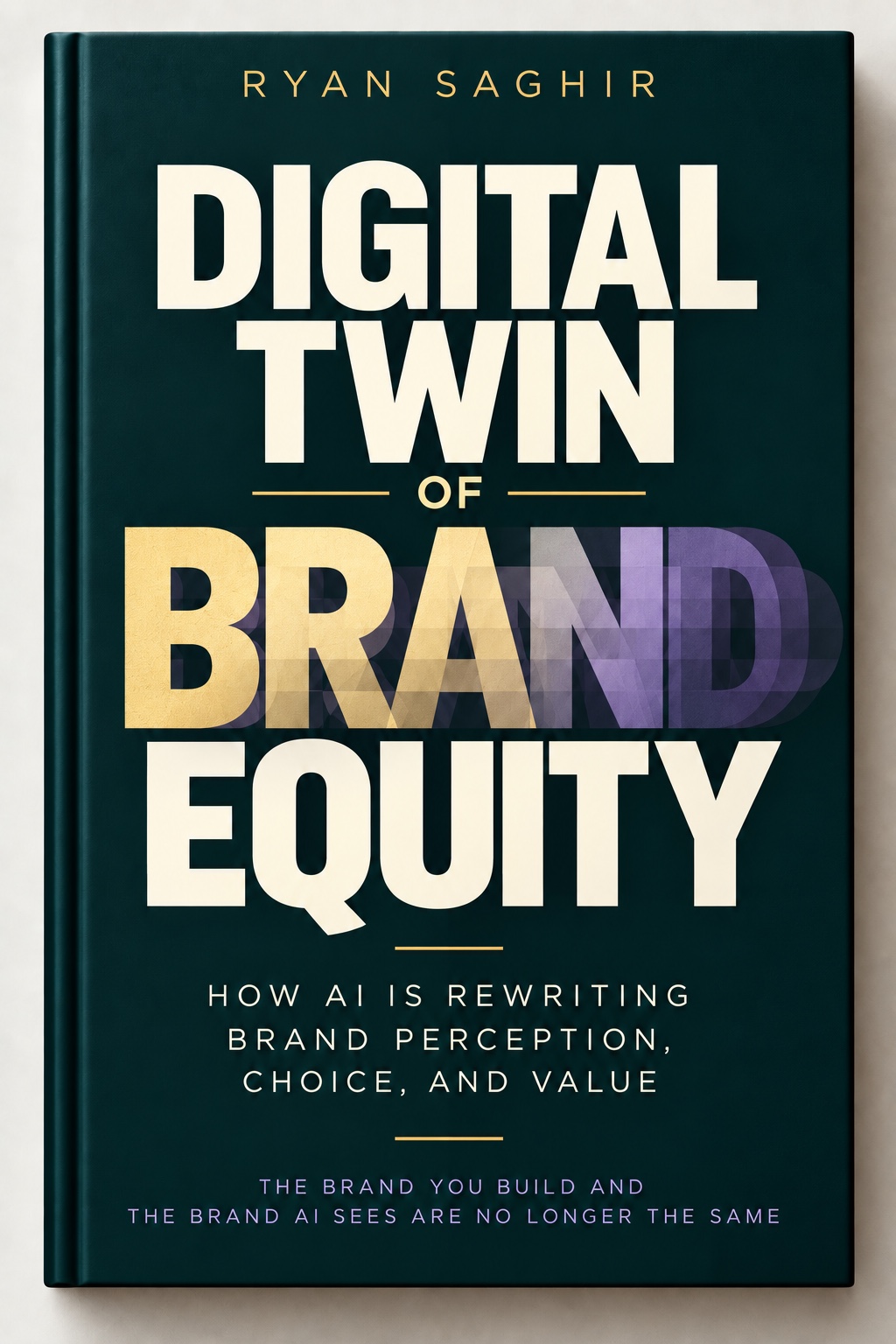
A brand book records the company an organization wants people to recognize. An AI system encounters the company through whatever learned associations and available evidence are relevant to the task. The distance between those two accounts is now a brand-management problem.
Consider a hypothetical company that has repositioned around specialist expertise. Its website explains the new direction, but older product listings, reviews, and comparisons still describe a general-purpose provider. A system drawing on those sources can continue placing it in the old category. The new strategy exists. The public evidence has not caught up with it.
This example illustrates the argument; it is not a reported case or a measured effect. To establish the gap for a real company, we would need the company's intended position, the actual AI outputs, and the conditions under which those outputs were collected.
The operating trail becomes evidence
Digital Twin of Brand Equity names the machine-facing representation that emerges from a brand's accumulated public signals, associations, credibility, and contextual presence. Marketing contributes to that representation alongside customer experiences, product information, employees, partners, reporting, and public records. DTBE calls that operating trail the Brand Wake.
The company can publish a clear claim while leaving contradictory traces through the way it operates. Brand teams therefore need to examine the evidence supporting their position across the enterprise. A message that travels widely but lacks operational support remains vulnerable to the evidence people and systems encounter elsewhere.
The framework builds on Kevin Lane Keller's account of brand knowledge and associations, Charles Fombrun and Mark Shanley's research on reputation, and Michael Merz, Yi He, and Stephen Vargo's stakeholder-focused account of brand value. Companies have never had complete control over what their brands mean. DTBE's proposed contribution is to connect those traditions to machine-facing representation, the decisions it helps mediate, and the governance needed to observe and influence that process.
Follow the representation into the decision
The site follows four questions: how the system represents a brand, which brands it brings into discovery, how it evaluates the alternatives, and which option reaches a recommendation or choice. Each question requires its own evidence. A favorable description does not guarantee inclusion in a buying task. A recommendation does not demonstrate that a person bought the product.
Statistical Availability captures the likelihood of being surfaced, associated with relevant concepts, and framed with confidence. Its measurement remains conditional on the system, task, evidence, and collection window. A mention count can reveal one part of the pattern while missing an unfavorable association or an irrelevant category position.
The strongest objection
An AI answer can differ from the brand book because the prompt is poor, the source information is stale, or the system makes an error. That answer does not establish a durable brand asset or a commercial consequence. Treating every mismatch as proof of the whole DTBE thesis would make the framework impossible to test.
The response is to preserve the conditions and compare patterns. Keep the prompt, system, interface, date, access settings, sources, and output. Include cases where the system accurately represents the company. Test the relevant tasks rather than selecting the most dramatic answer, and separate observed descriptions from explanations of why they appeared.
A concrete management task
A brand team can begin with one strategically important association and inspect whether it survives across relevant tasks. Compare the intended proposition with the public evidence and the generated answers. Where the evidence is outdated or contradictory, assign the underlying facts and operating signals to the people who can correct them. Where the model varies, document that variation before promising improvement.
The brand book remains useful. Its claims now need to survive contact with the wider trail the business leaves and the systems that interpret it.