The starting point
Brands are being interpreted by machines before people encounter them.
A guide to brand representation, discovery, evaluation, and choice in an AI-mediated world.
AI systems describe companies, compare their products, and recommend alternatives. Before a person evaluates those options, the system has already assembled an account of what each brand is and why it belongs in the answer.
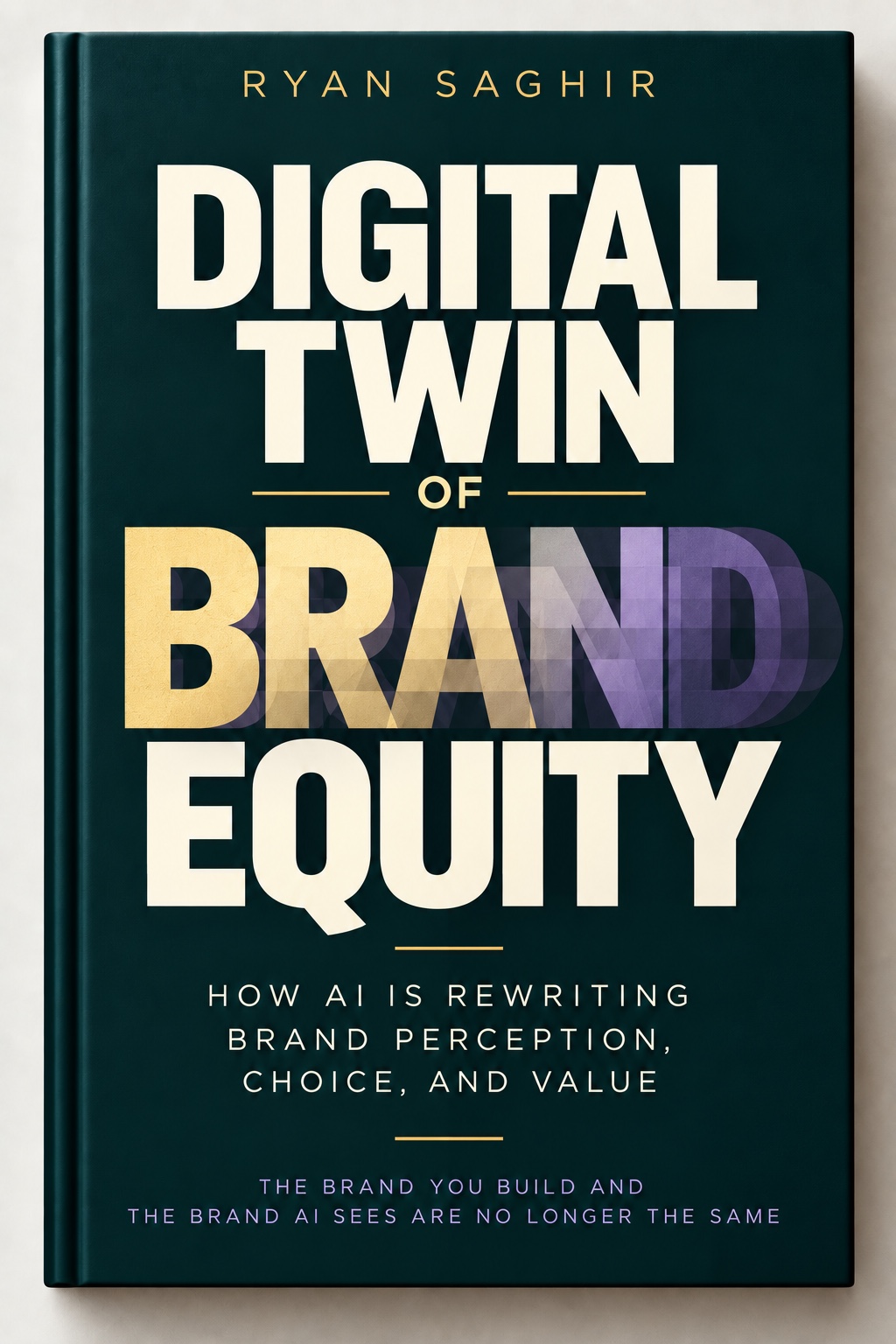
Digital Twin of Brand Equity investigates that account and its consequences for brand strategy. The framework names the machine-facing representation that emerges from a brand's accumulated public signals, associations, credibility, and contextual presence. It asks how that representation participates in discovery, evaluation, and choice.
Start with the problem
A company states its position through marketing, but the evidence about it spreads much further. Customer experiences, product information, employees, partners, reporting, and public records leave a Brand Wake. AI systems can encounter those traces when constructing an answer. What the company intends and what the system expresses can diverge.
The Brand You Built Is Not the Brand AI Sees develops that argument and sets out a concrete way to investigate it.
Follow four questions
Representation asks how AI describes and interprets the brand. Discovery asks whether it enters consideration. Evaluation asks how it compares with alternatives. Choice asks which option reaches a recommendation or purchase. These are questions to investigate, not a measured conversion funnel.
The Semantic Entity explains why the account varies with the system and task. Statistical Availability concerns whether the brand is surfaced, associated with relevant concepts, and framed with confidence.
Use the library, then read the arguments
The Concept Library gives each term a definition, mechanism, and boundary. Canonical definitions record the current DTBE vocabulary. Working constructs and emerging hypotheses carry their status openly. A settled definition does not make every claim about its effect an established finding.
The essays develop arguments and observations. What is the Semantic Entity? is a useful next step for understanding the object of study. The access essay examines a different question: how the information and actions available to an agent can change what it recommends.
What the framework claims
DTBE builds on established work on brand memory, associations, distributed reputation, and machine-mediated shortlisting. Its proposed contribution connects those traditions into a framework for machine-facing representation and cross-functional signal governance.
Observed AI outputs, human behavior, and economic value remain distinct. The publication makes those boundaries visible so an argument can be tested and revised as the evidence develops.